Other services
Whether you’re cutting down trees near a power line, starting a dig or need information on power line maintenance, we’re here to help. You can also make a free cable enquiry, claim compensation for damage or read more about land use and line clearance practices.
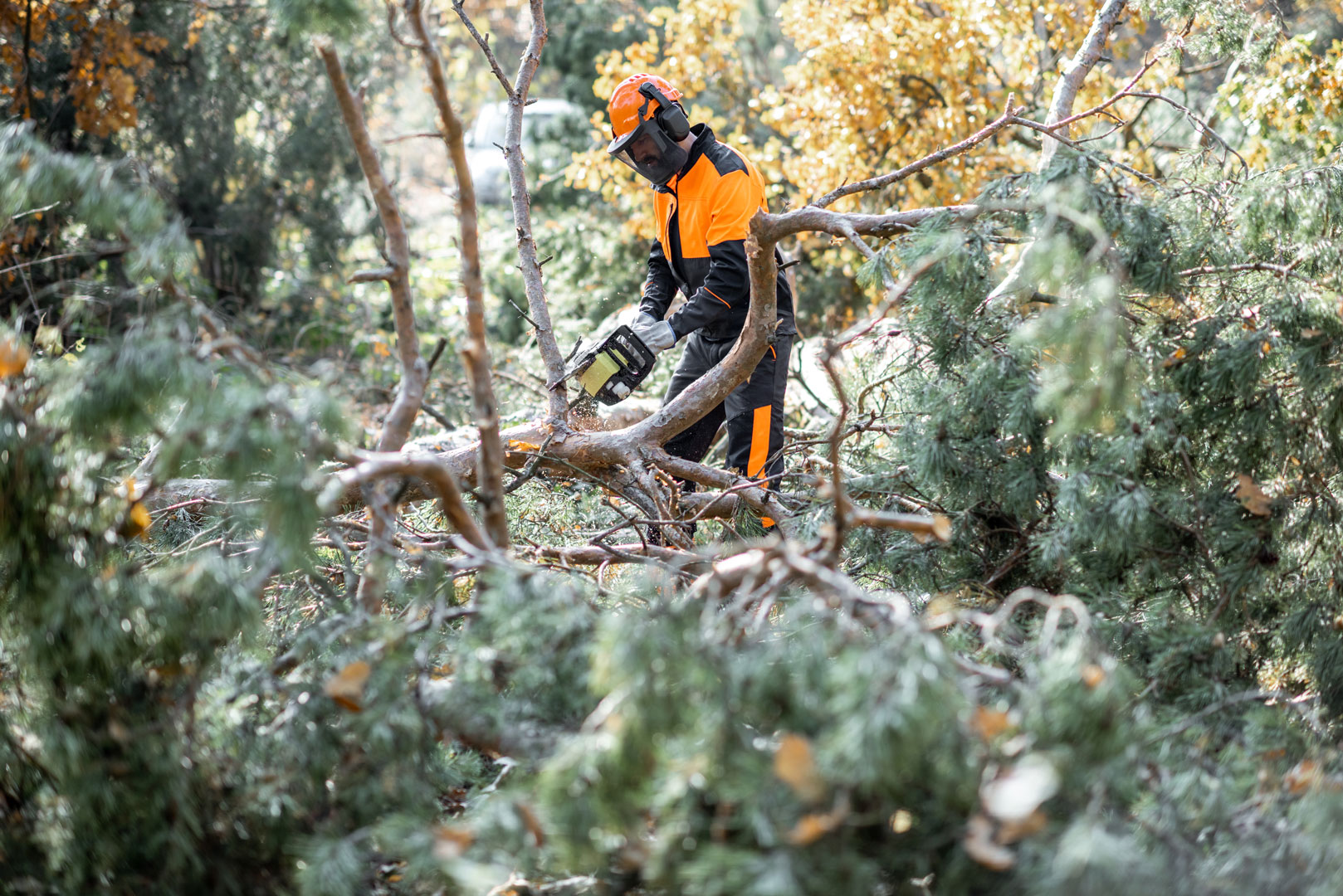
Wood harvesting
Are you planning to cut down a tree or trees near an overhead power line?
You know that trees growing next to power lines should be felled by a professional.
The first thing to do is to contact a qualified forester who can assess how to do the job safely without damaging the power lines. Once the forester has assessed the situation, you can ask us for a woodworking permit. We recommend that you contact us at least two weeks before the planned felling.
Has a tree fallen on a power line?
Always remember that if a tree has fallen on a power line , you must not attempt to remove it yourself because of the risk to life.
Clearing trees from power lines should always be done by professionals, as the work is demanding and dangerous for both the operator and the power grid.
In the event of an accident, call our 24/7 helpline on 0800 9 2500 immediately. Wait for your call to be answered or to be connected to a recorded incident information line, where you can leave a message about the location of a fallen tree, for example.
Remember to stay as far away from the damaged line as possible, and do not touch any wires that have fallen to the ground. Also make sure that no one else can reach the lines until help arrives.
Cable display
Are you about to start digging?
Excavation work on larger projects, including small domestic sites, can damage or even break underground cables or pipelines in the electricity network.
Check the location of any underground cables by carrying out a free cable survey.
The cable enquiry is made on Geomatikk’s online portal no later than four working days before the start of the excavation. If special arrangements are required for possible cable installation, for example due to water, it is recommended that the enquiry is made two weeks before the work is due to start. In special cases you can contact Geomatikk’s customer service.
By using the portal, you can process your cable enquiries quickly and accurately. You can track the progress of your case and see your previous enquiries and their documentation.
Fill in the form for the cable survey on web-survey.co.uk. The first time, you will need your online banking credentials to verify your identity. Strong authentication is related to the security of critical infrastructure. The form asks for the subscriber’s contact details and details of the excavation site and the reasons for the excavation.
Once the cable enquiry is registered in the system, you will receive an identifier that will allow you to check the progress of your case on the portal or by calling customer services. If necessary, you can get help filling in the form by calling Geomatikk’s customer service.
If, despite all precautions, an accident occurs during excavation work or cables are unexpectedly discovered in the excavation, you must leave the vicinity of the cable immediately. The digger must immediately inform the electricity company. Even if the cable is not visibly damaged, the distribution company must be notified in case of latent faults.
The Kajave electricity distribution area includes Hyrynsalmi, Kajaani, Kuhmo, Paltamo, Puolanka, Ristijärvi, Sotkamo, Suomussalmi, Pyhäntä and the area of the former Kestilä municipality in Siikalatva municipality.The first thing to do is to contact a professional forester who can assess how to do the work safely without damaging the power lines. Once the forester has assessed the situation, you can ask us for a woodcutting permit. We recommend that you contact us at least two weeks before the planned felling.
Land use
The right to use the pipeline area is agreed with the landowner
The construction of electricity distribution is always subject to a distribution plan, which also includes a terrain plan. The use of land along the route of the electricity network is agreed with the landowners and property owners, whether they are private individuals, companies, local authorities, municipalities, the state or other bodies.
The concession agreement and the siting permit give Kajave the right to build new and maintain the existing network. New electricity network construction includes the installation of underground cabling and overhead lines, as well as associated equipment and structures such as park transformers and branch and distribution cabinets.
Contractual terms and conditions and compensation
The terms and conditions of the concession agreement for the transmission area follow the model agreement published in October 2017 by the Energy Industry, the Confederation of Finnish Agricultural Producers and the Swedish-speaking Farmers’ Confederation. The compensation for concessions is based on the compensation recommendations mentioned below *).
Landscape planning will be carried out by Kajave’s contractor
The site planning is carried out by a contractor authorised by Kajave, who draws up a concession agreement or a low-voltage line permit and presents the project to the landowner. The landowner and the property owner will then have the opportunity to make comments, for example on the layout of the cables and wires.
The contract is signed by the owner(s) of the property and the owner of the property, if different from the owner. If there is more than one owner of the property, the contract must be signed or authorised by all of them. Each party will receive a copy of the agreement.
Kajave will pay the landowner a lump sum for the right to use the pipeline area, as calculated, after the parties have approved the agreement. Once the compensation has been paid, construction of the pipeline can begin.
Kajave to build electricity distribution with contractors
In larger construction projects, the contact details of contractors are indicated on site signs located on access routes alongside roads on the way to the site. If you have any questions about the site or the construction work, you can contact the contact details on the site sign or Kajave Technical Customer Service.

Pipe screens
Knowledge of the plumbing in the area is important. Before you dig, it’s a good idea to order a network survey. The easiest way to do this is to visit the network survey portal or call customer service on 072 758 0700.
Clearance of conducting areas
A wide range of tasks are carried out in the vicinity of power lines, from forest management to storm damage restoration. Every summer, trees are cleared from power lines. Cooperation with landowners is key to tree clearance
We clear around 1400-1600 kilometres of trunk roads every year. We publicise the clearance in various ways so that landowners can harvest the trees if they wish.
Under the terms of the concession agreement with the landowner, the trees removed from the line areas are the property of the landowner. Clearance is carried out by external contractors who are trained to take account of environmental issues and electrical safety, among other things.
Depending on the maintenance plan for the network and the growing conditions of the trees in the areas, clearance is carried out every 6-10 years. The need for clearance is also monitored during network condition inspections.
Forest management also affects the extent of storm damage
Forest owners have an important role to play, as the amount of storm damage is greatly influenced by the way forests are treated in the vicinity of power lines. Storms cause the most damage to forests that have been thinned or felled to the seed-tree stage and have just been treated. Kajave works closely with forestry organisations and experts.
To ensure uninterrupted electricity supply, the Finnish Energy Industry Association and its partners have produced a guide on how to manage the vegetation around power lines. The guide is not an obligation, but a recommendation that forest owners are encouraged to follow. The recommendation mainly concerns the management of vegetation around medium-voltage 20 kV (kilovolt) lines.
A professional can help – order a logger for woodcutting
Always hire a professional forester if you plan to cut down trees where a power line runs through the felling area! The feller will always pay for any damage caused to third parties.
If a tree is growing in a really awkward place in the immediate vicinity of a medium-voltage line, contact us using the form here and our experts will help.
Each case is individually assessed and our experts plan in advance protective measures, such as specialised cable lowering or push-pulls.
We will assist and order the measures from a clearing or networking contractor. We will carry out the work as soon as possible, depending on the extent of the protective measures and the contractor’s work situation. Please note that if we have to cut off the electricity supply to neighbours during the work, they must also be informed. Costs will depend on the size and location of the tree to be felled. Households may be entitled to a household deduction from the logger’s wages.
We always use external contractors who are experts in working near power lines to carry out the clearance. They also understand environmental issues. This way we ensure the safety of the work.
Clearing includes clearing the ground beneath the power line and, if necessary, pruning and removal of edge trees. Individual trees outside the line area that pose an immediate risk to power supply and safety are removed. The clearance will prevent trees from growing closer than the minimum distances to the power lines. The planned clearance cycle is 6 to 10 years.
Clearance of medium and low-voltage lines
On medium-voltage lines, we generally clear trees up to a width of 10 metres. Multi-conductor structures can be wider, usually with the edge of the conductor area five metres from the nearest pole. Branching should not extend closer than 2.5 metres to the conductors, taking into account the swaying of the conductors and the growth of branches.
Low-voltage lines do not require a conductor area, but the distance between the line and trees must be at least half a metre. Any trunks directly under the line shall be removed. Tree branches or trunks must not damage the conductor.
The trees to be removed belong to the landowner, so they are left on the land.
Application for compensation
If our activities have caused damage to your property, you can claim compensation from us using the claim form.
For more information and guidance on completing your application, please contact our chat service or customer service.